
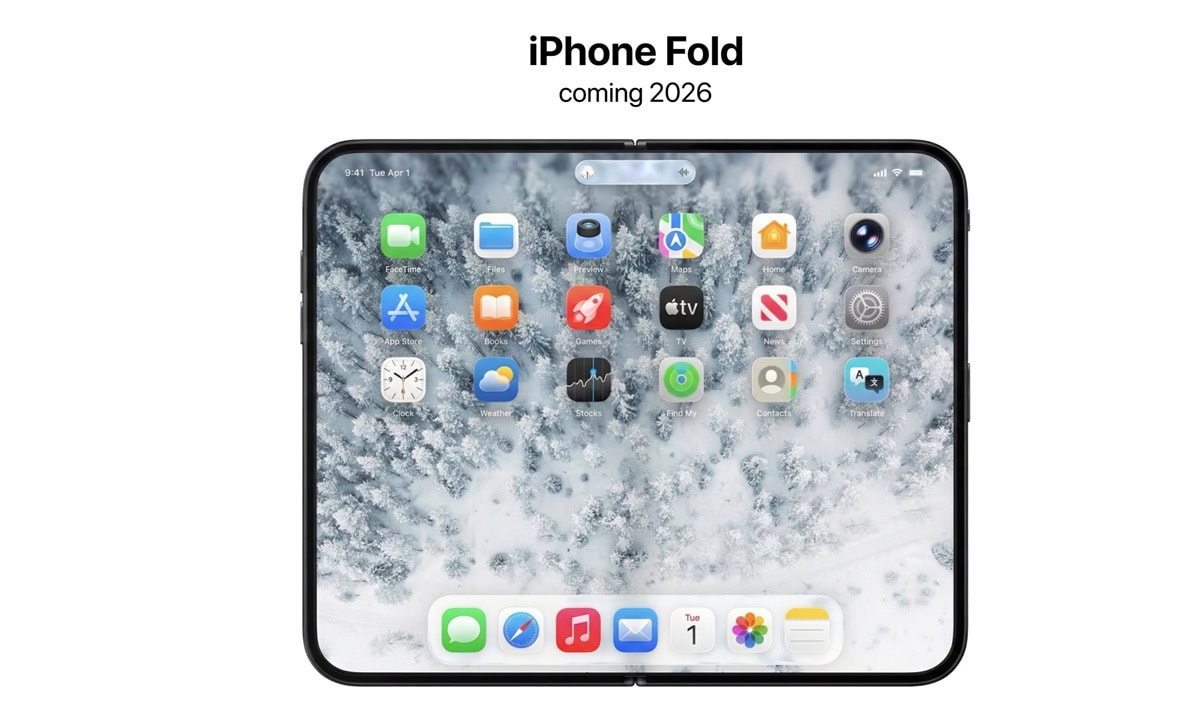
Let me cut to the chase: Apple's finally making a foldable iPhone, and it's happening in 2026. After watching Samsung stumble through seven generations of foldables, Apple's been quietly perfecting what they hope will be the device that makes foldables mainstream.
I've been tracking these rumors for over two years now, and the picture is finally clear. The iPhone Fold isn't just another iteration on the iPhone formula — it's the most significant hardware change since Steve Jobs pulled the original iPhone out of his pocket in 2007.
What Is iPhone Fold?
The iPhone Fold is Apple's first foldable smartphone, designed to combine the portability of a regular iPhone with the screen real estate of an iPad mini. When closed, it's a compact 5.5-inch phone you can use one-handed. When opened, it transforms into a 7.8-inch tablet.
Apple's going with a book-style design (think Samsung Galaxy Z Fold) rather than a flip-phone style (Galaxy Z Flip). This means the device opens horizontally like a book, not vertically like an old Motorola Razr.
Unlike every other foldable on the market, the iPhone Fold reportedly has a nearly invisible crease. Apple supposedly pursued this "regardless of cost" — and that's reflected in the $2,000+ price tag.
Why Did Apple Wait So Long?
Samsung released their first Galaxy Fold in 2019. That's seven years before Apple's entry. So what took so long?
According to multiple reports, Apple refused to launch a foldable until they could solve two problems that plague every current foldable:
- The crease: That visible fold line down the middle of the display that you can see and feel. Apple's reportedly solved this with liquid metal hinges and a new display technology.
- Durability: Early foldables broke easily. The iPhone Fold's hinge is rated for over 1 million folds — significantly more than competitors.
Design & Build Quality
The iPhone Fold's design philosophy is classic Apple: thinner and more refined than the competition, even if it means some compromises.
4.5mm Unfolded
Thinner than iPad Pro when open. Apple's thinnest device ever made.
9mm Folded
Roughly the thickness of two stacked iPhones. Fits in most pockets.
Book-Style Fold
Opens horizontally like a book. 4:3 aspect ratio when unfolded.
Liquid Metal Hinge
New material eliminates visible crease. Rated for 1M+ folds.
Dimensions
| Measurement | Specification |
|---|---|
| Folded Height | 120.6mm |
| Folded Width | 83.8mm |
| Folded Thickness | 9.0 - 9.5mm |
| Unfolded Thickness | 4.5mm Thinnest Ever |
| Frame Material | Titanium + Aluminum |
| Hinge Material | Specially Treated Liquid Metal |
| Display Glass | Ultra-Thin Glass (Lens Technology) |
On the Size
Think of it like a passport when closed. The 4:3 aspect ratio when unfolded makes it feel like a mini iPad rather than a stretched phone — that's intentional. Apple believes the unfolded experience is where you'll spend most of your time.
Display Technology
Here's where the iPhone Fold really flexes (pun intended). Apple's display tech is legitimately impressive.
Inner Display (Unfolded)
- Size: 7.76-7.8 inches diagonal
- Resolution: 2713 × 1920 pixels
- Aspect Ratio: 4:3 (similar to iPad)
- Technology: Foldable OLED with LTPO
- Refresh Rate: 1-120Hz ProMotion
- Crease: Nearly invisible
Outer Display (Folded)
- Size: 5.49-5.5 inches diagonal
- Resolution: 2088 × 1422 pixels
- Aspect Ratio: 4:3
- Technology: OLED with LTPO
- Refresh Rate: Up to 120Hz

Apple developed a "new material property" for the display that makes the crease nearly invisible. Combined with the liquid metal hinge that distributes stress more evenly, this should be the first foldable where you genuinely forget there's a fold.
Complete Specifications
| Component | Specification |
|---|---|
| Processor | Apple A20 Pro (TSMC 2nm) New |
| RAM | 12GB LPDDR5X |
| Storage Options | 256GB / 512GB / 1TB |
| Inner Display | 7.8" OLED, 2713×1920, 120Hz |
| Outer Display | 5.5" OLED, 2088×1422, 120Hz |
| Rear Cameras | Dual 48MP (Wide + Ultrawide) |
| Inner Camera | 24MP Under-Display |
| Outer Camera | 12MP Front-Facing |
| Battery | 5,400-5,800mAh (split configuration) |
| Wireless Charging | 25W (MagSafe) |
| Wired Charging | USB-C, up to 45W |
| Biometrics | Touch ID (side button) — No Face ID |
| 5G | Apple C2 Modem with mmWave |
| Water Resistance | IPX4 (splash resistant) |
| Operating System | iOS 27 |
| Colors | Space Black, White |
A20 Pro Chip Performance
The A20 Pro is built on TSMC's 2nm process — a first for any smartphone. Here's what that means:
- 15% faster CPU compared to A19 Pro
- 30% better power efficiency
- 45 TOPS Neural Engine for Apple Intelligence
- WMCM packaging — RAM integrated directly with CPU/GPU
Camera System
The iPhone Fold takes a slightly different approach to cameras than the iPhone 18 Pro. The priority here was keeping the device thin, so Apple went with a dual camera setup rather than a triple.
48MP Main
Same sensor as iPhone 17 Pro. Excellent low-light performance.
48MP Ultrawide
13mm focal length. Macro photography supported.
24MP Under-Display
Hidden under inner screen. For video calls when unfolded.
12MP Cover Camera
On outer display for selfies and Face ID alternative apps.
Pro Tip
You can use the outer display as a viewfinder while shooting with the rear cameras. This means you can take selfies using the high-quality 48MP main camera — a significant advantage over regular iPhones.
iOS 27 Foldable Features
iOS 27 is being designed specifically with the iPhone Fold in mind. Here's what to expect:
Split-Screen Multitasking
Run two apps side-by-side on the 7.8" inner display. iPad-style productivity.
App Continuity
Apps seamlessly transition when you fold/unfold. No interruption.
Flex Mode
Use phone partially folded for video calls, watching content, or photography.
Outer Display Widgets
Quick glance info without unfolding. Notifications, weather, calendar.
iPhone Fold vs Samsung Galaxy Z Fold 7
The obvious comparison. Samsung's been doing foldables for seven years. How does Apple's first attempt stack up?
| Feature | iPhone Fold | Galaxy Z Fold 7 |
|---|---|---|
| Inner Display | 7.8" (4:3) | 8.0" (20:18) |
| Outer Display | 5.5" | 6.5" |
| Unfolded Thickness | 4.5mm | 4.8mm |
| Crease Visibility | Nearly invisible | Visible |
| Processor | A20 Pro (2nm) | Snapdragon 8 Gen 5 (3nm) |
| Hinge Durability | 1M+ folds | 800K folds |
| S Pen Support | No | Yes |
| Price (Base) | ~$2,399 | ~$1,899 |
The Verdict
Samsung wins on outer display size, price, and S Pen support. Apple wins on build quality, crease invisibility, processor performance, and (arguably) the unfolded experience thanks to that 4:3 aspect ratio.
If you're already in the Apple ecosystem and want the best-built foldable on the market, iPhone Fold is worth the premium. If you want the best value or need that stylus, Samsung's still the pick.
Price & Storage Options
Let's address the elephant in the room: the iPhone Fold is expensive. Really expensive.
| Storage | Expected Price |
|---|---|
| 256GB | $2,000 - $2,399 |
| 512GB | $2,199 - $2,599 |
| 1TB | $2,399 - $2,799 |
Three reasons: crease-free display technology that competitors don't have, liquid metal hinge materials, and Apple's typical premium positioning. This is a first-generation product for Apple, and they're not competing on price — they're competing on quality.
Release Timeline
Engineering Verification Testing
~100 units being tested. Hardware design finalized.
Mass Production Begins
Foxconn ramps up manufacturing. 3-5M units planned for launch.
Apple Event & Pre-Orders
iPhone Fold announced alongside iPhone 18 Pro. Pre-orders open same week.
Launch Day
iPhone Fold ships. Limited availability expected initially.
Second Generation
iPhone Fold 2 expected. 20M units projected (combined with gen 1).
Due to manufacturing complexity, initial supply will be limited. If you want one at launch, pre-order immediately when they go live. Smooth availability likely won't happen until early 2027.
Frequently Asked Questions
Stay Updated on iPhone Fold
We'll update this page as new information emerges. Bookmark and check back for the latest news.