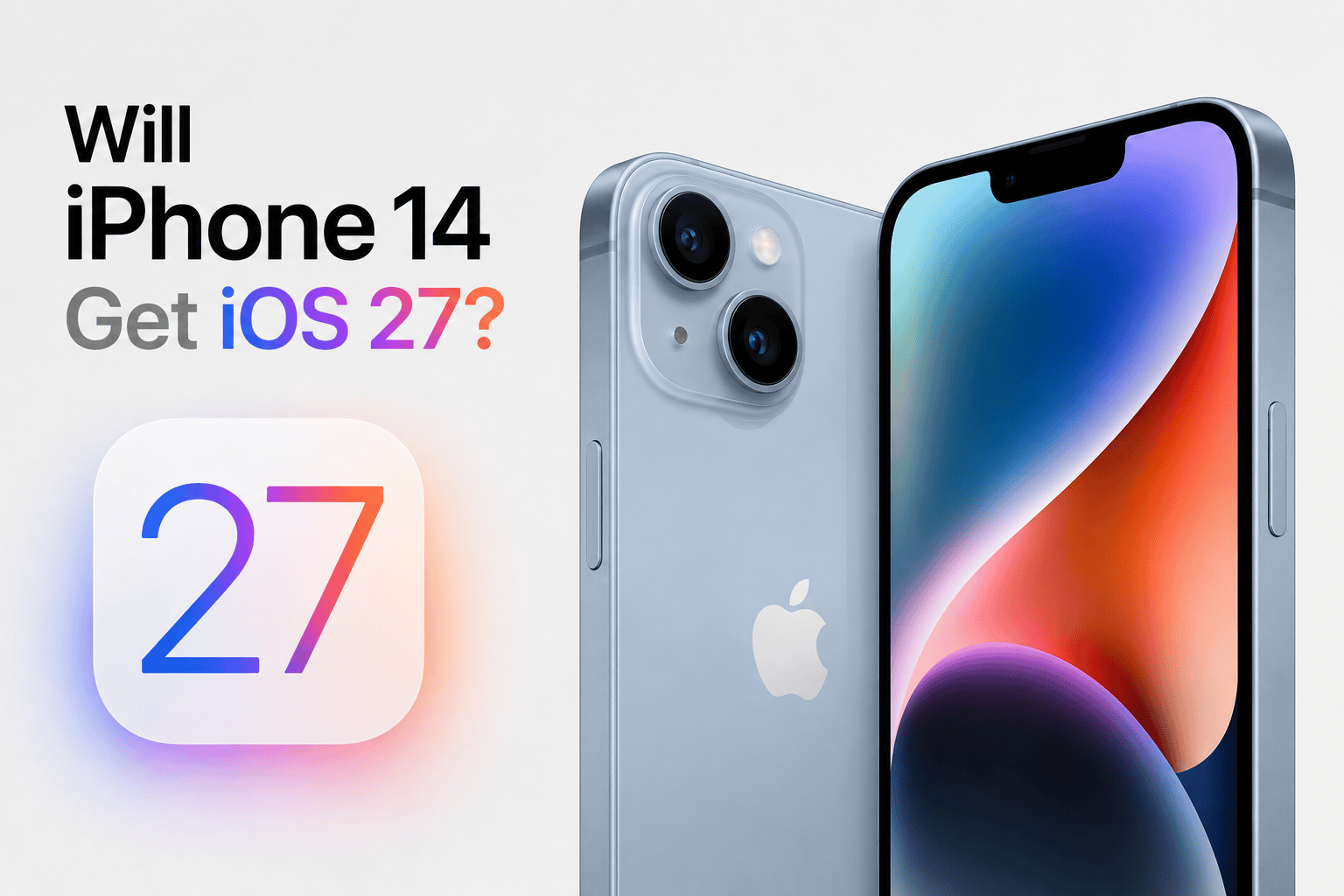
If you're holding an iPhone 14 right now, the good news is simple: you're not getting left behind this year. Apple's iOS 27 supported devices list keeps every model released since 2020, and the iPhone 14 lineup sits comfortably in the middle of that range — nowhere near the cutoff.
But "supported" is doing a lot of heavy lifting in 2026. Ever since Apple split its software into an AI tier and a non-AI tier, the real question for most people isn't whether their phone gets the update. It's how much of the update they actually get. And the iPhone 14, despite being only a few years old, lands on the wrong side of that line.
This guide walks through exactly what iOS 27 looks like on an iPhone 14 — the features you'll enjoy, the ones you'll never see, the performance you can realistically expect, and whether any of it justifies an upgrade.
Is the iPhone 14 Officially Supported?
Yes. Apple confirmed the WWDC 2026 dates in March, and iOS 27 will be unveiled on June 8. While Apple hasn't published the final compatibility list yet — that always comes on keynote day — every credible report and the underlying chip requirements point to the same conclusion: the iPhone 14 family is safe.
iOS 27 carries forward the same baseline as iOS 26: it requires an A14 Bionic chip or newer, which means every iPhone from the iPhone 12 onward stays on the list. The iPhone 14 and 14 Plus use the A15 Bionic. The iPhone 14 Pro and 14 Pro Max use the A16 Bionic. Both chips are generations ahead of the cutoff, so there is no realistic scenario where any iPhone 14 model gets dropped.
What You Get vs. What You Miss
Here's the cleanest way to think about it. Every major iOS 27 feature falls into one of two buckets on the iPhone 14 — included, or hardware-locked out.
- Rebuilt conversational Siri
- Multi-turn Siri chat with memory
- New Siri chat-style interface
- Liquid Glass 2.0 design refinements
- Rumored glass intensity slider
- Snow Leopard performance work
- Battery and memory optimizations
- Redesigned Calendar app
- Updated Photos with smarter albums
- Expanded satellite messaging
- Safari privacy improvements
- Battery charge limit shortcut
- New wallpapers and customization
- Every security patch and bug fix
- Apple Intelligence Writing Tools
- AI summaries across Mail and Notes
- Image Playground image generation
- Genmoji custom AI emoji
- AI photo cleanup and object removal
- Priority and smart Mail sorting
- AI notification summaries
- On-device Siri personalization
- Siri "World Knowledge" web answers
- 5G satellite internet (hardware-locked)
- iPhone Fold multitasking layouts
The pattern is consistent: anything driven by Apple Intelligence's on-device large language model needs the A17 Pro chip or newer. Everything else runs across the entire supported lineup, including your iPhone 14.
A15 vs. A16 Bionic: The Two-Tier iPhone 14
One detail many iPhone 14 owners miss is that the lineup isn't built around a single chip. Apple used the previous year's A15 Bionic in the standard iPhone 14 and 14 Plus, then reserved the newer A16 Bionic for the 14 Pro and 14 Pro Max. For iOS 27, that distinction matters less than you'd think — but it's worth understanding.
Both chips share the same 16-core Neural Engine generation and both ship with 6GB of RAM, which is the real reason multitasking on iOS 27 stays smooth across the whole lineup. The A16 has a slightly faster CPU and a more efficient 4nm process, but for a stability-focused release like iOS 27, that gap is mostly invisible in daily use. The most noticeable difference remains the display — Liquid Glass 2.0 animations simply look better at 120Hz on the Pro models.
Crucially, neither chip clears the bar for Apple Intelligence. The A16 Bionic was the chip that introduced the always-on display and the Dynamic Island, but it predates the architectural changes Apple built into the A17 Pro specifically for on-device generative AI. That's why the iPhone 14 Pro — a phone that still feels premium in 2026 — gets the same AI treatment as the standard iPhone 14: none of it.
Performance and Battery on iOS 27
Here's where the news gets genuinely positive. iOS 27 is being described as a "Snow Leopard" release — a callback to the 2009 Mac update that shipped with almost no new features and instead focused entirely on speed, stability, and cleaning up the code underneath. Reports indicate Apple engineers have spent this cycle hunting down bloat, eliminating long-standing bugs, and tightening memory management across the operating system.
For a phone like the iPhone 14, that's arguably the best kind of update to receive. The flashy AI features were never coming to this hardware anyway. But the performance and efficiency work? That benefits every supported device, and older phones tend to feel the improvement most.
A realistic expectation: your iPhone 14 should feel the same or marginally snappier on iOS 27 than it did on iOS 26, and battery life should hold steady or improve slightly once the post-update indexing settles down. The first day or two after any major update always brings a temporary dip while the system re-indexes photos, rebuilds caches, and finishes optimizing apps in the background — that's normal and not a sign of anything wrong.
Why the iPhone 14 Misses Apple Intelligence
This is the part that frustrates people, and it's worth explaining properly rather than just stating it. The iPhone 14 Pro launched in late 2022 at a premium price. Watching it get cut out of the headline feature set just a few years later feels harsh — so why is Apple drawing the line where it is?
The short version: Apple Intelligence runs large AI models directly on the device, and that requires a specific class of hardware. When Apple introduced the platform, it set the A17 Pro as the minimum. Two things drive that requirement.
The Neural Engine generation. The A17 Pro's Neural Engine was substantially reworked compared to the A15 and A16. On-device generative models — the kind that power Writing Tools or Image Playground — need that newer architecture to run at acceptable speed without destroying battery life.
Memory and bandwidth. Running a language model on a phone is memory-hungry. The A17 Pro pairs more capable memory bandwidth with the chip, and Apple Intelligence-class devices ship with at least 8GB of RAM. The iPhone 14 lineup tops out at 6GB, which isn't enough headroom to hold these models resident while the rest of the system keeps running smoothly.
Is there a frustrating element of product segmentation here? Almost certainly — Apple has commercial reasons to keep its newest AI features tied to its newest hardware. But there's also a genuine engineering floor, and the iPhone 14 sits just below it. The A16 Bionic was a brilliant chip for its era; it simply wasn't designed with on-device LLMs in mind.
iPhone 14 vs. iPhone 14 Pro on iOS 27
If you're choosing between models on the used market, or just wondering whether your Pro is meaningfully ahead, here's the practical comparison for iOS 27 specifically.
| Aspect | iPhone 14 / 14 Plus | iPhone 14 Pro / Pro Max |
|---|---|---|
| iOS 27 support | Yes | Yes |
| Apple Intelligence | No | No |
| New conversational Siri | Yes | Yes |
| Liquid Glass 2.0 | Yes (60Hz) | Yes (120Hz) |
| Animation smoothness | Good | Excellent |
| Performance headroom | Solid | Slightly better |
| Satellite messaging | Yes | Yes |
The honest summary: on iOS 27, the iPhone 14 Pro's advantage over the standard iPhone 14 is the same advantage it had on day one — the 120Hz ProMotion display and a touch more processing comfort. iOS 27 doesn't widen that gap, and it doesn't introduce any software feature that one gets and the other doesn't. If you own the standard iPhone 14, you are not missing an iOS 27 feature that Pro owners are enjoying.
How Long Will the iPhone 14 Keep Getting Updates?
Apple doesn't publish a guaranteed support window, but its track record is remarkably consistent: roughly six to seven years of major iOS updates per iPhone, followed by a stretch of security-only patches.
The iPhone 14 launched in September 2022. iOS 27 in 2026 is its fifth major update. Following the historical pattern, it should reasonably expect major updates through somewhere around iOS 29 or iOS 30 — carrying it into 2029, possibly later. After that, expect another year or two of security updates even once the big feature releases stop.
Should You Upgrade or Hold On?
For the vast majority of iPhone 14 owners, the answer is straightforward: hold on, install iOS 27, and enjoy a phone that runs better than it did before. You're getting a smarter Siri, a refined interface, real performance gains, and years of remaining support. That's a good deal for doing nothing.
The case for upgrading comes down to a few specific situations:
- You genuinely want Apple Intelligence. If Writing Tools, Image Playground, AI Mail sorting, or the deeper Siri personalization sound essential to how you'd use your phone, the iPhone 14 will never deliver them. The floor is the iPhone 15 Pro.
- Your battery health is poor and you're due for a change anyway. If the phone already feels tired, the timing of a new iPhone in September 2026 — alongside the iPhone 18 lineup and the rumored iPhone Fold — makes waiting a few months worthwhile.
- You want the newest hardware features. Things like the rumored 5G satellite connectivity are hardware-locked and will never reach the iPhone 14 by software.
But if you don't care much about AI features and your battery is still in decent shape? There's no urgency. The iPhone 14 on iOS 27 is a perfectly capable phone, and Apple's "Snow Leopard" approach this year means it'll likely feel better after the update, not worse. If anything, this is the rare year where holding onto older hardware is rewarded.
How to Install iOS 27 on iPhone 14
When iOS 27 arrives, getting it on your iPhone 14 is simple — and you no longer need a paid developer account for the beta. Since 2024, both the developer beta and the public beta have been free for anyone with an Apple ID.
- For the beta (from June 8): Go to Settings → General → Software Update → Beta Updates, then select the iOS 27 beta channel. The update will appear on the Software Update screen like any normal update.
- For the stable release (mid-September): Just open Settings → General → Software Update once iOS 27 is officially out, and tap Download and Install.
Before you update — beta or stable — back up your iPhone 14 first. Use iCloud or a computer backup, and make sure you have at least 8 to 10GB of free storage so the installer has room to work. Beta software in particular can be unstable in its early builds, so if your iPhone 14 is your only phone, the public beta in July is the safer entry point than the day-one developer beta.